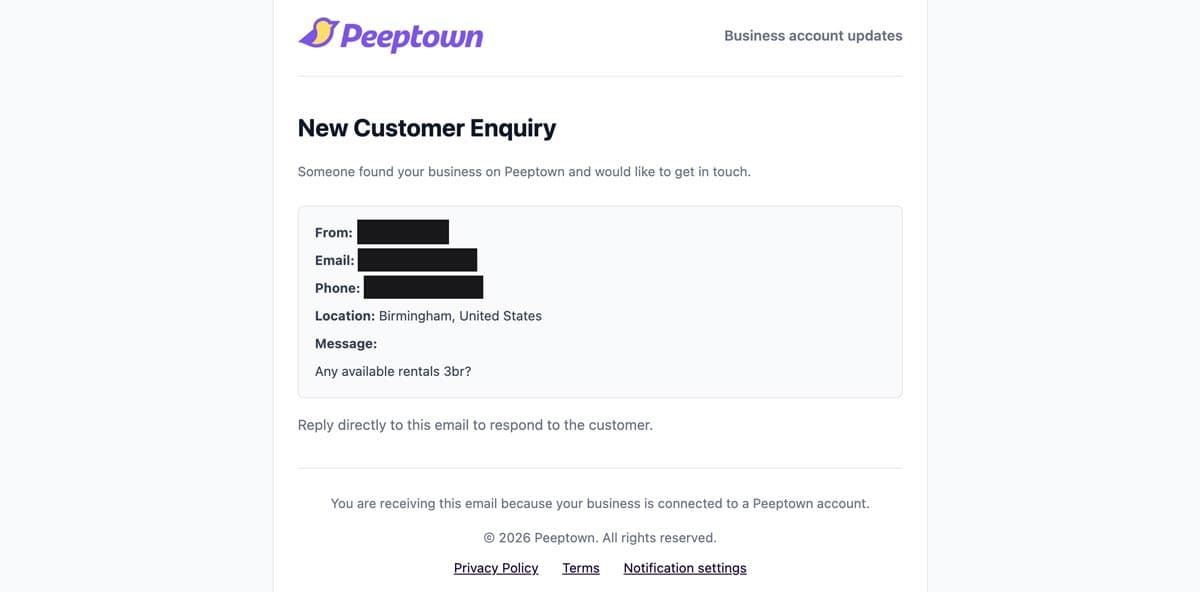
Today, a simple enquiry told a much bigger business story. A customer found a rental business profile on Peeptown and sent a direct message asking about available 3-bedroom rentals in Birmingham, United States. The customer had intent. They were not casually browsing. They had a real need, a location, and a clear question.
That is exactly the kind of moment every rental business wants: someone discovers the business online and reaches out before choosing another company. But there was a problem. The business profile was not properly maintained. The right contact email was not provided, the profile was not verified correctly, and the company may not even know that a possible customer was trying to reach them.
The customer name, email, and phone should always be protected when sharing this kind of example. The lesson is not about exposing a customer or blaming one company. The lesson is about a larger problem across the rental and property services industry in the United States: many businesses have online profiles created for visibility or backlinks, but those profiles are not owned, updated, or managed like real sales channels.
A 3-bedroom rental enquiry is not a small thing
For a rental agency, apartment manager, property management company, or real estate rental business, an enquiry about a 3-bedroom rental can represent serious revenue. It may lead to a showing, an application, a lease, a deposit, monthly rent, future referrals, or a relationship with a family that stays for years.
Even if that exact enquiry does not close, it still gives the business valuable market information. Someone is searching in that area. Someone wants that bedroom count. Someone trusts the profile enough to ask. That is demand speaking directly to the business.
When the profile is not maintained, that demand can disappear quietly. There may be no phone call, no reply, no booking, no showing, and no second chance. The customer simply moves to another rental company that looks more reachable.
The hidden damage is bigger than one missed lead
A missed enquiry is painful, but the bigger damage is trust. From the customer side, it looks like the business did not respond. The customer does not know that the email may be wrong or that an outside SEO person created the profile years ago and never handed it properly to the owner. The customer only feels ignored.
In rental services, silence creates doubt fast. Housing searches are emotional and time-sensitive. Customers may be moving for work, family, school, safety, or cost reasons. If a business does not respond, the impression is simple: this company may not be organized, active, or serious.
That impression can hurt more than losing one enquiry. It can affect reviews, word of mouth, repeat visibility, and the customer’s confidence in the brand.
The backlink problem in local SEO
Many business owners hire SEO teams to create listings across directories and local platforms. That can be useful when done responsibly. The problem starts when the profile is treated only as a backlink, not as a customer-facing business asset.
A backlink mindset asks one question: can this profile help ranking? A business-owner mindset asks better questions: can customers contact us here, is the information correct, who receives enquiries, are services updated, are photos current, is the profile verified, and can we measure the leads?
When profiles are created only for SEO, the rental business may get visibility without control. That is dangerous. Visibility without ownership can bring customers to a dead door.
Rental customers search with urgency
People searching for rentals in the United States often search by location, bedroom count, availability, price range, pet policy, school area, commute, lease terms, and move-in date. They want answers quickly because good rentals can disappear fast.
A renter asking about a 3-bedroom property is already giving the business useful information. They may need space for children, remote work, relatives, or shared living. They may be comparing neighborhoods, trying to move soon, or checking availability before submitting an application.
If the rental business profile does not show current contact details, service areas, available property types, office hours, enquiry options, and response expectations, the business is making the customer work too hard.
What a rental business profile should do
A proper online profile should not be a thin listing with a name and address. For rental and property businesses, it should work like a compact customer gateway. It should help people understand what the company offers and how to take the next step.
- Show the correct business name, phone number, email, location, and service area.
- Explain whether the business handles apartments, single-family rentals, condos, short-term rentals, vacation homes, property management, leasing, or tenant placement.
- Make it clear how customers can ask about availability, schedule a viewing, request a call, or start an application conversation.
- Keep photos, descriptions, hours, FAQs, and contact options current.
- Make sure enquiries go to the owner, manager, leasing team, or the right staff member.
- Verify and claim the profile so the business controls the information.
Why ownership matters
A profile that the business does not own is a risk. If the email is outdated, leads go nowhere. If the phone number is wrong, customers lose trust. If the business category is inaccurate, the wrong people enquire. If the profile is unverified, the owner may not be able to update quickly when things change.
Rental businesses change constantly. Availability changes. Staff changes. Office hours change. Service areas change. A business that manages properties in Birmingham, Atlanta, Dallas, Phoenix, Tampa, Charlotte, or any growing US rental market cannot afford stale information.
Owning the profile is not just a marketing task. It is operational discipline. It connects visibility with responsibility.
Peeptown turns profiles into business tools
Peeptown is built for business owners who want more than a backlink. A Peeptown Biz account helps owners maintain a public business profile, add services or products where relevant, manage contact details, collect enquiries, add FAQs, add social links, show business hours, and build a stronger online presence.
For rental and property businesses, that means the profile can explain the company clearly and guide interested renters or landlords toward the right action. A property management company can describe leasing, tenant placement, rental management, maintenance coordination, and owner services. A rental agency can explain available property types and enquiry steps.
The key is simple: when customers find the business, the business should be ready.
Premium branding makes the profile feel owned
A basic profile can help a business start showing correct information, but many serious rental and property companies need stronger branding. Peeptown Premium can support custom domain branding, a premium profile, advanced SEO and sharing tools, more services, custom booking or enquiry forms, team access, and a more professional presentation.
That matters because rental customers are making important decisions. They are not buying a small item. They are choosing a home, a neighborhood, and a company they may need to communicate with for months or years.
A branded profile with a custom domain can help the company look more established without immediately spending four figures on a separate website project. The business can use Peeptown as a faster path to a professional online presence while keeping enquiries and profile tools connected.
The no-commission advantage
Peeptown does not charge commission on bookings or sales. For businesses that use enquiry, booking, product, service, or payment features, this difference matters. Some platforms make businesses pay repeatedly for access to the same customer relationship. Peeptown’s model is designed to help owners build direct visibility and keep more control.
Payment providers such as PayPal may still charge their own processing fees where payment tools are used, but Peeptown does not take a percentage from the owner’s booking or sale income.
For rental and property service businesses, the bigger point is freedom. The owner should not be trapped depending only on portals, aggregators, lead sellers, or profiles created by someone else. A business should have its own place online that customers can trust.
What rental businesses should check this week
This story should push every rental and property business owner to run a quick profile audit. Search your business name, category, location, and common customer phrases. Look at what customers see before they ever reach your website or office.
- Is the email correct?
- Is the phone number correct?
- Is the profile claimed and verified?
- Does the enquiry go to someone who will respond quickly?
- Does the profile explain what rental services you actually provide?
- Are photos, hours, categories, and locations accurate?
- Is there a clear path for customers asking about availability?
- Does the profile make the business look alive, trustworthy, and ready?
If the answer is no, the business may already be losing customers without seeing the loss. That is the painful part. A missed enquiry does not always announce itself. It just becomes another customer who chose someone else.
A customer found you. Now be ready for them.
The most important lesson from today’s enquiry is simple: getting found is only the first step. If a real customer reaches out and the profile is not maintained, the business has not completed the job.
For US rental agencies, apartment rental companies, property managers, and real estate rental businesses, online visibility should lead to action. A renter asking about a 3-bedroom home should not disappear into an unmonitored inbox.
Peeptown gives business owners a way to take back control: claim the profile, correct the contact details, present services clearly, respond to enquiries, and build a profile that works for the business instead of only existing as an SEO footprint.
Because the next enquiry may not be a test. It may be the customer your business was waiting for.
FAQ
Why do rental businesses lose online leads?
Rental businesses lose leads when profiles have wrong contact details, outdated information, weak descriptions, no verification, slow response times, or no clear path for customers to ask about availability.
Is creating business profiles only for backlinks a problem?
It can be. Business profiles can support SEO, but if they are created only for backlinks and not maintained, customers may contact the wrong email or get no response. That damages trust.
What should a property management company add to its profile?
A property management company should add service areas, leasing services, tenant placement, maintenance coordination, owner services, office hours, enquiry steps, FAQs, photos, and correct contact details.
Can Peeptown help rental businesses get direct enquiries?
Yes. Peeptown helps owners maintain a public profile with correct information, services, FAQs, contact details, and enquiry paths so customers can reach the business more directly.
Does Peeptown charge commission on leads or bookings?
Peeptown does not charge commission on bookings or sales. Payment processors may charge their own fees if payment tools are used, but Peeptown does not take a percentage from the owner’s income.